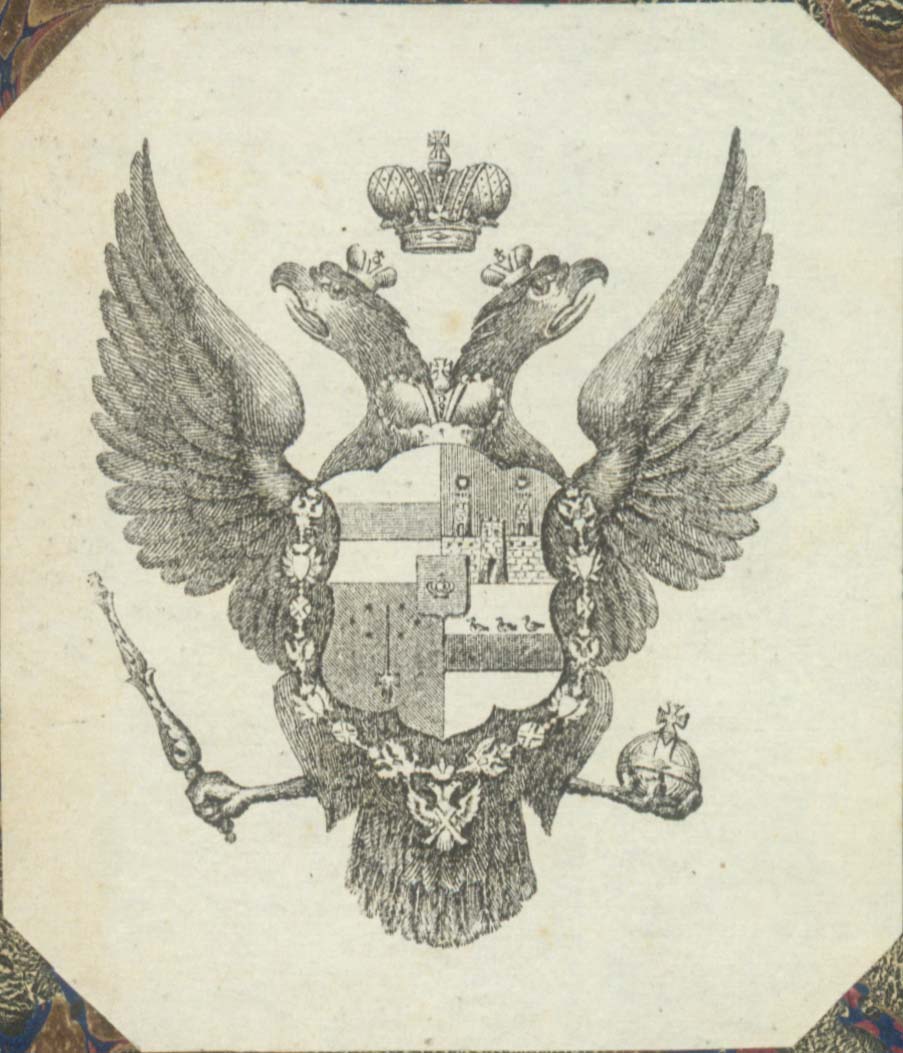
Maximilian de Beauharnais Plate
Item
-
Date of Book
-
1851
-
Title
-
Maximilian de Beauharnais Plate
-
Description
-
Heraldic. Crest: the Russian imperial crown; Arms: quartered, 1st an azure fess on an argent field (Leuchtenberg); 2nd an argent wall flanked by two towers, all masoned and with argent openings, two vert trees issuing from the towers (Eichstätt); 3rd an argent sword erect with a gold hilt on a vert field accompanied by seven gold stars; 4th a sable fess accompanied in chief by three martlets of the second on an argent field (Beauharnais); overall, a gold royal crown on an azure shield; Supporting: double-headed imperial eagle holding a scepter (sinister) and orb (dexter) in their talons.
-
Context
-
Maximilian Joseph Eugene Auguste Napoleon de Beauharnais (1817-1852) was the son of Eugène de Beauharnais, Duke of Leuchtenberg and Prince of Eichstätt and Princess Augusta Amalia Ludovika Georgia of Bavaria. He was raised in Munich, largely by his mother, following the death of his father when he was just six years old. As a teenager, he was made commander of the 6th Regiment of the Bavarian Cavalry by his grandfather, Maximillan I Joseph and later promoted by his uncle Louis I of Bavaria to colonel of the regiment of Uhlans. He inherited the duchy of Leuchtenberg when his older brother died childless in 1835. During a military visit to the Russian Empire, Maximilian developed a romantic attachment to Grand Duchess Maria Nicholayevna who he married at the Winter Palace in 1839. The early years of their marriage were happy and produced several children; however, Maria began an affair with Count Gregorei Alexandrovich Stroganov, and it is widely believed that the count, and not Maximilian, was the father of their children Eugen, Sergei, and George. As part of the terms of his marriage, Maximilian served in the Russian military, but he was limited by his status as an outsider. He was an avid collector in the arts and sciences, and he was appointed an honorary member of the Russian Academy of Sciences and president of the Imperial Academy of Arts by his father-in-law, Nicholas I. Maximilan fell ill following a mineral expedition, and despite trips abroad to improve his health, he finally died in St. Petersburg in 1852.
-
Rights
-
The copyright and related rights status of this Item has not been evaluated. Please refer to the organization that has made the Item available for more information. You are free to use this Item in any way that is permitted by the copyright and related rights legislation that applies to your use.