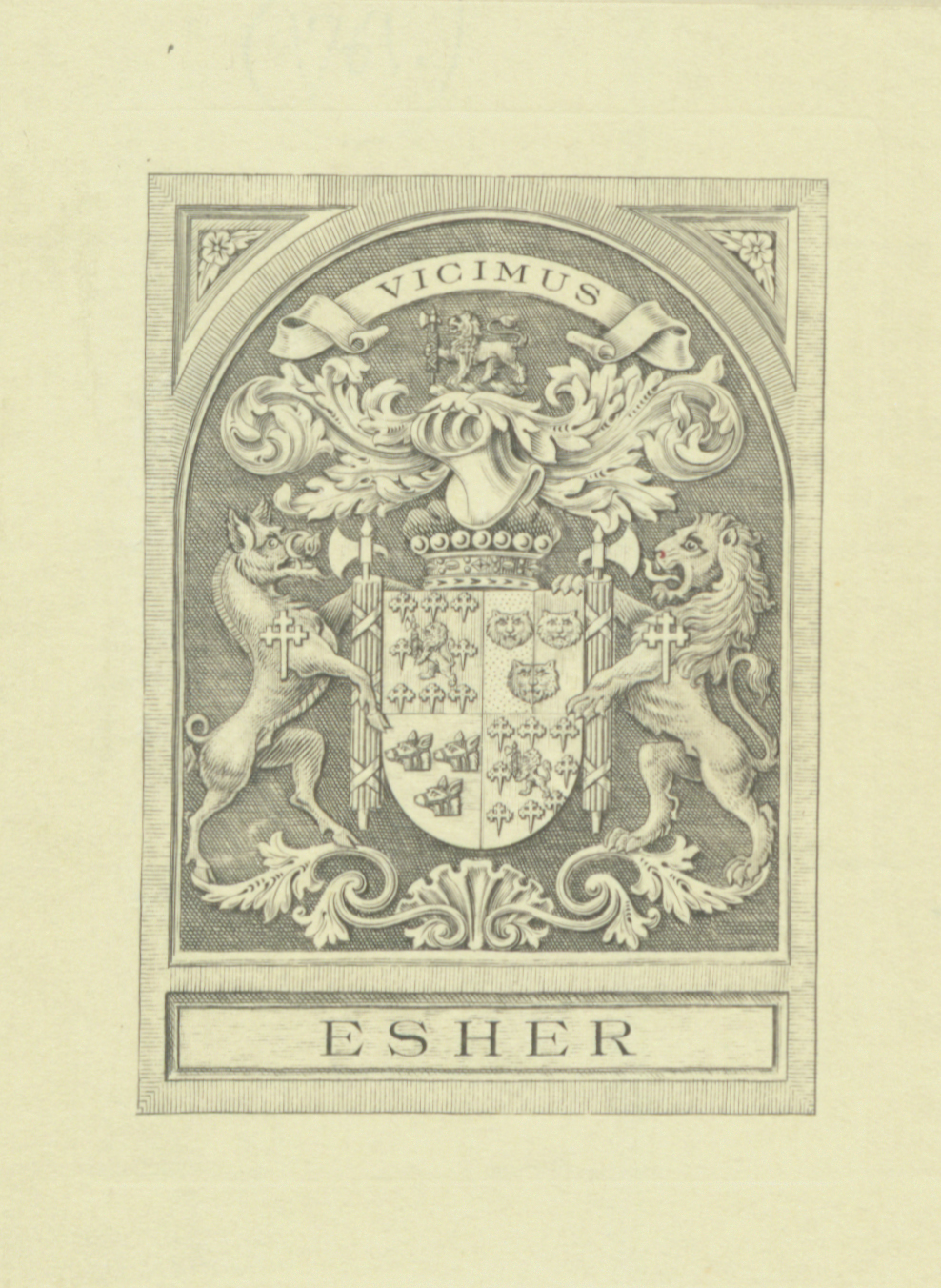
Esher Plate
Item
-
Date of Book
-
1914
-
Owner
-
Esher
-
Title
-
Esher Plate
-
Description
-
Heraldic. Crest: A lion passant gules charged on the shoulder with a cross botonny fitchéee gold and holding in the dexter forepaw a fasces proper; standing on barred helmet with mantling and the coronet of a viscount; Arms: quartered -- 1st & 4th Gules within an orle of crosses botonny fitchée gold a lion rampant of the last holding in the dexter forepaw a fasces erect proper 2nd per pale gold and gules three leopard's faces counterchanged 3rd azure three bears' heads couped argent muzzled gules; supported by dexter a boar sinister a lion both sable and each charged on the shoulder with a cross botonny fitchée gold and holding between the paws a fasces erect proper; Motto: Vicimus- We have conquered.
-
Context
-
Reginald Baliol Brett (1852-1930) was the son of William Baliol Brett, an eminent barrister and Member of Parliament, who was made the 1st Viscount Esher in 1897, and Eugenie Mayer, daughter of Finette and Lazare Mayer. He was educated at Eton and later at Trinity College, Cambridge. His university ties, namely that of radical lawyer William Harcourt, influenced his decision to reject his father’s political views and become a member of the Liberal Party. In 1879, Brett married Eleanor Frances Weston Van de Weyer, daughter of the Belgian ambassador. The couple had four children: Oliver Sylvain Baliol Brett, Maurice Vyner, Lady Dorothy Eugenie, and Sylvia Leonora. Despite having an amicable marriage, Brett was known to have relationships with men throughout his life; he published a collection of Uranian poetry, Foam (1893), under the name R.B. Brett.
Beginning in 1895, Brett served as Permanent Secretary to the Office of Works where he developed close ties to the royal family, including an aging Queen Victoria; following her death, he published a three-volume set, The Letters of Queen Victoria, in 1907. Brett’s career was largely distinguished by the influence he exerted behind the scenes of military and political affairs. Following the 2nd Boer War, he worked to advance Edward VII’s military reforms and forwarded military appointments. During the First World War, with the assistance of his son, Maurice, he was instrumental in providing the British with intelligence. In 1922, Brett was sworn into George V’s Privy Council and in 1928 was made Constable and Governor of Winsor Castle, which office he held until his death.
-
Rights
-
The copyright and related rights status of this Item has not been evaluated. Please refer to the organization that has made the Item available for more information. You are free to use this Item in any way that is permitted by the copyright and related rights legislation that applies to your use.